Friday, February 28, 2014


Monday, February 17, 2014
Compound Interest Formula
Compound Interest Formula:
formula: 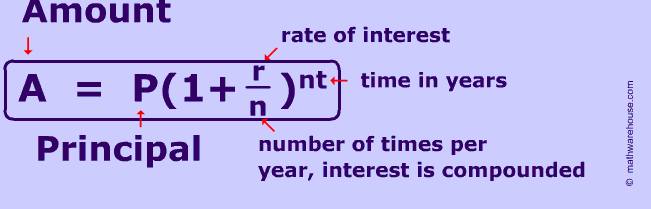
P= principal
A= amount
N= number of times per year, interest is compounded
T= time in years
R= rate of interest
Wednesday, February 5, 2014
Graphing Exponential Growth/Decay
GRAPHING EXPONENTIAL GROWTH/DECAY:
y= aŸbx-h+k
a= multiplier
a>1 = stretch 0<a<1 = compression
a<0 (negative) = flipped over x-axis
b= base
b>1 = GROWTH (always increasing)
0<b<1 = DECAY (always decreasing)
h= left/right (opposite)
k= up/down
Domain
(-∞,∞) = All Real numbers
Range: y>k (Positive)
y<k (Negative)
Asymptote
y=k
Tuesday, January 28, 2014
General Forms of a Sequence
General Forms Of A Sequence:
~Sequence: series (list) of numbers
~Arithmetic: sequence of numbers such that the difference between the consecutive terms is constant.
-example- 5,7,9,11,13,15... is an arithmetic sequence with a difference of 2.
-example- 5,7,9,11,13,15... is an arithmetic sequence with a difference of 2.
-formula- an= a1+(n-1)d d=an-an-1
d= common difference
~Geometric: sequence of numbers where each term after the first is found by multiplying the previous one by a fixed, non-zero number called the common ratio.
-example- 2,6,18,54... is a geometric sequence with a common ratio of 3.
-example- 2,6,18,54... is a geometric sequence with a common ratio of 3.
-formula- an=a1 x rn-1 r= an ÷ an-1
r= common ratio
Wednesday, January 15, 2014
Characteristics of Graphs
Characteristics of Graphs:
Domain: x-values
Range: y-values
End Behavior: description of what happens on both ends
Absolute Max/Min: 1 highest/lowest point
Local Max/Min: more than 1 highest/lowest point
Interval of Increase: what happens to a graph(y values) as you move along x-axis if y values are increasing
Interval of Decrease: what happens to a graph as you move along x-axis if y values are decreasing
X Intercept: (a,o)
Y Intercept: (o,b)
Symmetry: even: symmetric about y-axis
odd: symmetric about origin
Neither: none
Even/Odd/Neither: even: symmetric about y-axis
odd: symmetric about origin
Neither: none
Asymptotes: imaginary line that a graph gets closer and closer to but never touch
Function: describing what happens to a graph (function)
One to One: passes both vertical and horizontal line test

example of a functon (above)
Domain: x-values
Range: y-values
End Behavior: description of what happens on both ends
Absolute Max/Min: 1 highest/lowest point
Local Max/Min: more than 1 highest/lowest point
Interval of Increase: what happens to a graph(y values) as you move along x-axis if y values are increasing
Interval of Decrease: what happens to a graph as you move along x-axis if y values are decreasing
X Intercept: (a,o)
Y Intercept: (o,b)
Symmetry: even: symmetric about y-axis
odd: symmetric about origin
Neither: none
Even/Odd/Neither: even: symmetric about y-axis
odd: symmetric about origin
Neither: none
Asymptotes: imaginary line that a graph gets closer and closer to but never touch
Function: describing what happens to a graph (function)
One to One: passes both vertical and horizontal line test
example of a functon (above)
Subscribe to:
Posts (Atom)